Seiten

Posts mit dem Label Google Books; Google Search werden angezeigt. Alle Posts anzeigen

01.03.14

7 Google Search services you might want to use in class

Google Search is simply great for teaching. It is most often used by teachers for preparation and less commonly also in conjunction with the students's smartphones. Google Search is also great if used more or less spontaneously with a projector during a class.

In this tutorial video I give you examples of how the following seven Google Search services can be used in class
  1. Knowledge Graph
  2. Image Search
  3. Google Trends
  4. Google autocomplete
  5. Ngram viewer
  6. Google Search (graphing) calculator
  7. Google Search set time

12.11.12

Creating collaborative flashcards for mobile devices with Google Slides

Creating flashcards collaboratively with Google Slides is very simple. In Google Drive you need to create a new presentation for the flashcards and share it with your collaborators. Choose a template that suits you (I find “label” quite handy for flashcards). Create the title slide (e.g. “animal flashcards”) and a first slide, which serves as template for all others.

All other content slides are then created by duplicating the latter slide. The students can easily add content by using the search tool for images and typing the text underneath them. Alternatively photos uploaded to Picasa by the students themselves can also be used. Adding the “flip” transition to all slides even provides the feel of flashcards.
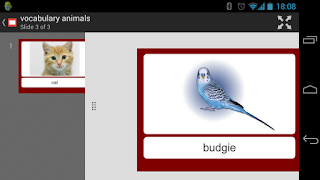
The final step would be to download the flashcards to mobile devices which can be done in different ways:
  • Using the Google Drive app
  • Downloading the slides as a file (pdf or pptx)
  • Using a browser and the shared URL

In order to permanently store the content on the phone the first two options are best. Google Drives allows for offline viewing when using the pin tool in the file menu. 

16.08.12

Why the classic Web 2.0 is going extinct in the Post-PC era

When Google announced last week that it would no longer support iGoogle, a one-time popular web 2.0 service, it became once more obvious to me that the classical web 2.0 is on its way out. More and more often the term “web 3.0” is used to refer to not as originally intended the semantic web but the mobile web, perhaps including cloud computing and social media. The term “web 2.0 itself has been superseded by “social media” and “cloud computing” (which have continued their basic functionality). I will be using Google Trends to show the waning interest in the classic web 2.0 here.

The first figure shows how “web 2.0” , which was coined in 2004, is being substituted by the terms “social media” and “cloud”, which in itself is the first indication of change.

By “classic” web 2.0 I refer to a set of typical features, which are

1.       The content is edited on a PC (word processor, photo editing software, etc.)

01.10.11

Need a native speaker? Ask Google x 2!

Ingredients:

Both teachers and learners of foreign languages often wish they had a native speaker at hand. While that wish frequently doesn’t come true, Google can be a serious substitute for a native speaker time and again.

21.09.11

“Sneaked” or “snuck”? Visualizing language change with Google Books Ngram Viewer

Have you ever wondered which form is more correct? “Sneaked” or “snuck”? Well, of course “sneaked” is British English and “snuck” is used by Americans, so discussing correctness does not really make much sense. But which form is the “original one”?

In language change forms often tend to become regular from irregular by means of “analogy”. So, “snuck” should have a good chance of being the original form. If you compare the two forms on Google Books Ngram Viewer, you will actually find out that the reverse is true: “snuck” sneaked into literary language sometime around the 1920s and started to become really popular in the 1980s (see image) (very likeley through a process called "hypercorrection" by linguists).

Beliebte Posts